
2025 year in review
Fund Highlights
Exceptionally strong and consistent performance
The following table shows the performance statistics for the fund. For references purposes, we have also included the MSCI Asia Pacific Index (in local currency).
Fund and Market Performance Statistics 2025 Source: OQFM, Bloomberg

Asia equity markets performed extremely strongly but with relatively high volatility and a significant drawdown. We achieved our objective of delivering consistently strong performance.
Increased HK/China gross exposure
Over the course of 2025, we increased China gross exposure as a percentage of total portfolio gross exposure from 56.7% to 117%.
We allocate capital to areas where we see the most compelling opportunity set. At present, we are finding attractive alpha‑generation opportunities in China, particularly across our universe of A‑H pairs.
Specifically, we highlight the only two companies whose H‑shares are currently trading at a premium to their corresponding A‑share listings: CATL (3750 HK and 300750 CH) and China Merchants Bank (3968 HK and 600036 CH).
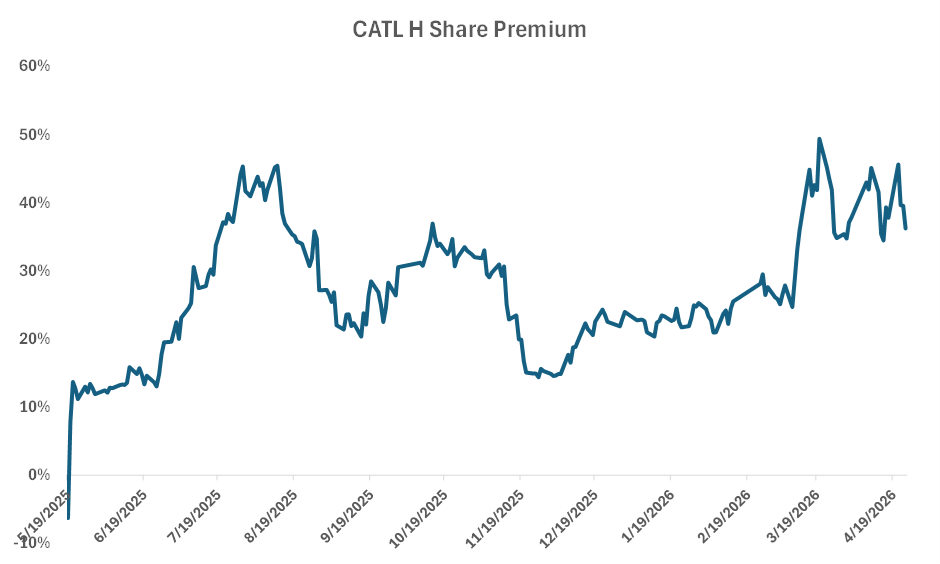
At year‑end, CATL’s H‑share premium was 23.6%, while China Merchants Bank’s H‑share premium stood at 12.6%. I have been following A‑H pairs for many years. While it is not unusual to see H‑share premiums, I have never encountered premiums of this magnitude. Typically, H-shares trade at a discount and, in many cases, this discount exceeds 50%.
I previously highlighted CATL’s H‑share premium in our August newsletter. At the time, it was 26.7% - even higher than the current level. However, CATL’s H‑share borrow cost was almost 18% per annum, making it difficult to exploit the mispricing anomaly. The H‑share premium subsequently declined, while the borrow cost remained elevated, and we ultimately closed out the A‑H pair.
Recently, however, the borrow cost has declined to around 2% per annum, while the H‑share premium has risen to near its all‑time high, creating an exploitable mispricing opportunity.
A long‑A and short‑H position in China Merchants Bank has the added benefit of a positive carry, as the dividend yield differential exceeds the borrow cost. Moreover, it is relatively easy to hedge the sector exposure, given that numerous Chinese bank H‑shares trade at substantial discounts, while the corresponding A‑share borrow costs are relatively low—in some cases, as little as 10 basis points per annum.
Higher idiosyncratic risk
Risk is an interesting topic that I’ve discussed at length before (https://www.oqfundsmanagement.com/post/the-potential-pitfalls-of-focusing-on-idiosyncratic-risk and https://www.oqfundsmanagement.com/post/analysing-risk-horses-for-courses). The challenge is not simply to minimise risk, but to take on the most appropriate type of risk given the mispricing opportunities being targeted.
For us, taking momentum and value bets aligns well with our investment process. Since these factors are recognised risk factors in commonly used risk models, they tend to dampen our idiosyncratic risk.
In 2025, we reduced the value and momentum tilts in the portfolio.
Value spreads continued to narrow during the year, and in all key markets — except Taiwan — are now below their longer-term averages. We discuss this development and include charts of value spreads later in the commentary.
We are currently cautious about taking a significant momentum bet, as equity markets appear expensive across numerous metrics. When markets sell off — and this will happen at some stage, with only the timing uncertain — it is typically the recent outperformers that are most adversely affected.
In 2025, we also increased our exposure to A-H pairs, as discussed in the previous section, which increases our stock-specific risk.
Finally, in 2025, we changed the composition of our China exposure to make it more balanced across different listing markets. We measure our net China exposure across our universe of Chinese stocks listed in Hong Kong (H-shares) and mainland China (A-shares). We also consider companies that are leveraged to Chinese demand and supply chains in other markets within our stock universe, particularly in Taiwan. For more details on this approach, refer to the following link: https://www.oqfundsmanagement.com/post/taking-a-holistic-approach-to-analysing-net-china-exposure.
Leading into 2025, we balanced our China exposure by being net long H-shares, net short A-shares and net short stocks with significant China exposure listed in other markets. This was to exploit the fact investors were being highly selective in expressing their bearish Chinese views by focussing primarily on H-shares.
The recent outperformance of H-shares has led to an unwinding of this positioning. In particular, we are no longer net long H-shares and net short A-shares.
The outcome of these portfolio changes is lower factor risk and an increase in idiosyncratic risk. This is not by design, but rather a by-product of the current market environment and our positioning to capture the most attractive alpha-generation opportunities.
Higher trading breadth
All quant strategies require high breadth. Because individual quant factors and models tend to have low predictive power, it is crucial to take as many independent bets as possible to enhance performance. As discussed in the Quant Factor Investing book on our website (https://www.oqfundsmanagement.com/factorinvesting), this principle is grounded in the Fundamental Law of Active Management: IR = IC × √Breadth.
We have always maintained a large number of positions in the portfolio — currently more than 1,300. More recently, I have come to appreciate the benefits of executing a high volume of trades daily, mostly initiated intraday, where we actively fine-tune position sizes based on short-term signals. Not every trade will generate alpha, but as long as we minimize trading costs and are right more often than we are wrong, we can deliver consistent portfolio alpha.
The following chart shows the time series of the median number of trades executed over the previous 20 trading days since the fund’s inception.
20 Day Median Number of Daily Trades Executed Source: OQFM

Leverage too low
The one downside to our 2025 performance record is that return volatility was well below our target level. We aim for an annualised volatility of around 7%, based on daily gross performance data. Our realised volatility for the year was only 4.8% per annum.
Given our investment strategy, the most effective way to increase fund return volatility would have been to take on additional leverage. As our capacity analysis has been deliberately conservative, we had room to do so. Had we employed higher leverage, headline fund performance would have been stronger.
Market Observations
AI and Tariff/Trump risk
We believe it is important to consider risk factors specific to the prevailing market environment that are not captured by risk models calibrated on historical data. When the fund was launched in 2020, the key risk factor was COVID‑19 — a dominant driver of market sentiment that was not fully captured by generic risk models.
The key environmental risk factor in 2025 was AI. Measuring AI exposure on an ex-ante basis remains challenging, as companies with significant AI exposure span multiple sectors, and the degree of exposure within each sector varies considerably. We discuss the importance of AI as a risk factor here: https://www.oqfundsmanagement.com/post/investor-sentiment-ai-as-a-risk-factor.
Another factor that significantly affected stock returns earlier in the year was tariff risk. On “Liberation Day” (April 2, 2025), the S&P 500 plunged nearly 4.8% amid new tariff announcements and heightened uncertainty surrounding trade policy, marking a significant decline and triggering recession fears. However, given the strong bull market in the second half of the year, this now appears to have been a relatively short-lived risk factor — though it could once again become important and it’s something we continue to monitor.
Declining value spreads
In Asia, we have seen a pronounced narrowing of value spreads in recent years, a trend that continued in 2025. This has been evident across all key markets in our stock universe, with the exception of Taiwan.
Our preferred methodology for measuring value spreads begins by excluding the most expensive stocks, defined as the bottom decile (10%) based on Book Yield. This initial filter is primarily a smoothing mechanism intended to reduce data volatility. From the remaining universe, we rank the stocks by Book Yield to construct the core portfolios: Long Portfolio: The top 30% (cheapest valuations). Short Portfolio: The bottom 30% (relatively expensive valuations, excluding the extreme outliers removed in the first step). Finally, the valuation spread is calculated as the ratio of the long portfolio's average yield to the short portfolio's average yield.
The following charts show a time series of value spreads for the key markets in our stock universe based on this approach.
Value Spreads for Asian Markets Source: OQFM, Factset


AH spread normalisation
The Hang Seng China AH Premium Index started the year at an extremely elevated level but declined sharply over the course of the year. It is now in line with historical averages .
AH Premium Index from 2015-2025 Source: OQFM, Bloomberg

Market inefficiencies
We subscribe to the view, articulated by Cliff Asness in his 2024 paper The Less Efficient Market Hypothesis, that equity markets have become less efficient in the short term. This inefficiency is particularly pronounced among stocks that are actively followed by retail investors. In the United States, there are numerous examples of such stocks, commonly referred to as "meme stocks."
In Asia, I believe the best large cap example of an overpriced meme stock is Aeon (8267 JP). In our November newsletter, I documented the extent to which retail investors have pushed the stock’s valuation to an absurdly high level.
Asia also has extreme dual listing ,conglomerate, and net cash pricing anomalies.
Among the dual-listed stocks we monitor, we have previously highlighted the extreme mispricing between TSMC’s U.S. and Taiwan listings — the same company with identical dividend entitlements, yet trading at vastly different prices. At year-end TSMC’s Taiwan listing traded at an 18.82% discount to its US listing.
I believe the largest dual-listing mispricings at year-end are found within the universe of A–H share pairs we monitor, particularly in the banking sector. For example, in our November newsletter, I documented the pronounced relative mispricing, based on both cross-sectional and time series analysis, between the A and H shares of China Merchants Bank and the Bank of China.
Among the conglomerates, we believe Misto (081660 KS), Legend (3396 HK), and LG Corporation (003550 KS) are the most mispriced. I have discussed Misto and Legend in previous monthly commentaries. LG Corporation exemplifies the “Korea discount” and is currently trading at an 56% discount to its net asset value (NAV).
Among our universe of stocks with significant net cash holdings relative to market capitalisation, we believe Poly Property Services (6049 HK) is the most mispriced. Its net cash holdings exceed 60% of its market capitalisation which, along with strong positive net cashflows, underpin its forward dividend yield of approximately 5%. It also has a decent growth profile driven by strong support from a top 5 SOE developer.
Chinese equities outperformance
Chinese stocks performed strongly in 2025. Market sentiment had been adversely affected in 2022 and 2023 by a range of largely irrational concerns loosely grouped under the banner of “investability” issues. Sentiment improved in 2024 as Chinese equities rebounded, and in 2025 they went on to outperform most major markets.
The following chart shows the 2025 calendar‑year performance of the headline indices across the key markets in our stock universe, along with the S&P 500 Index, which is included for reference.
Asian Market and S&P500 Performance 2025 Source: OQFM, Bloomberg

The KOSPI Index was the standout performer in 2025, driven largely by the strong share price performance of Samsung Electronics (005930 KS). The Hang Seng Index delivered the second‑best return for the year.
Quant Observations
High quant fund return volatility
We do not actively benchmark our performance against peers, as we view it as an unnecessary distraction. Managing clients’ capital is challenging enough without the added pressure of constant peer comparison.
However, in early December I read with great interest an excellent FT article titled Inside the “rolling thunder” quant crises of 2025. The article documented the extreme return volatility experienced by several quant funds and strategies (https://www.ft.com/content/4300b622-42b2-4fbb-bfcf-016e1b112bf9). All quotations below are drawn from that article.
The opening line reads:
“In October, Renaissance Technologies suffered a nightmare, with its two public hedge funds abruptly losing about 15 per cent, before soaring back in November.”
Our largest absolute monthly return in 2025 was 3.69%, and our only negative monthly return was -0.11%.
Notable quant events during the year included:
February: a “$900mn loss incurred by two investment teams at Millennium that specialise in index rebalancing arbitrage.”
April: following “Liberation Day,” significant losses were reported by leading trend-following funds (“Systematica’s BlueTrend and Man AHL’s Alpha funds lost 8.8 per cent and 4.3 per cent respectively”).
July: a “junk rally” resulted in weak performance across quality and defensive factors (“AQR’s Delphi and Apex funds suffered their worst months of what was otherwise a strong year in July, and RenTech’s two public funds suffered their first severe setbacks of 2025”).
October: another “quant tremor,” whose cause was “somewhat mystifying,” severely impacted RenTech’s performance. “The 14.4 per cent loss suffered by the roughly $18bn Renaissance Institutional Equities Fund in October was its biggest monthly loss in more than a decade, surpassing even the blows dealt by the Covid-19 pandemic in 2020.”
Given this backdrop, we are pleased to have had a relatively uneventful and successful year.
Increased crowding risk
We believe that crowding risk is more acute now than ever. The hedge fund industry is currently dominated by large multi-strategy managers, many of whom employ similar risk frameworks. These frameworks tend to favour certain quantitative strategies, increasing the risk of overcrowding.
A notable example is index rebalancing arbitrage. This strategy has strong intuitive appeal given the ongoing shift toward passive, long-only investing. However, the harsh reality is that when too much capital chases the same mispricing opportunity, the associated alpha is arbitraged away. In the worst-case scenario—when managers misidentify the companies expected to be included in an index—the scramble to unwind positions can trigger severe adverse price movements. As documented in the previous section, this is precisely what occurred in February.
Robust quant factor performance in Asia
Quant factor performance in Asia was robust. The folllowing chart shows the Rank IC by market for our composite quant score.
Composite Quant ICs for Asian Markets 2025 Source: OQFM, FactSet

There are myriad reasons why it is challenging to translate strong quantitative factor performance into strong fund performance. Managing a hedge fund requires disciplined risk controls and careful management of transaction costs. Moreover, measures of quant factor performance typically assume that all stocks can be shorted — an assumption that does not hold in many emerging Asian markets, where the shortable universe is limited and borrow costs can be high.
We also employ various discretionary overlays, which tend to dampen fund performance when quant factor performance is strong, and vice versa. For example, in 2020 — the most challenging period of the quant winter — fund performance held up relatively well.
Research Initiatives
Short term alpha signals
To support our increased trading breadth, we have devoted considerable time and effort to developing quant factors with robust short‑term predictive power. These include:
revision‑based factors derived from target price, recommendation, and analyst forecast data, and
a technical short-term reversal signal.
Pairs trading
I’m a big fan of pairs investing. Pairs provide an effective way to take risk‑constrained stock positions that target liquidity‑driven share price distortions.
In 2025, we devoted significant effort to identifying the most compelling pairs for trading and developing our own “pair strength” score. We tested several statistical techniques, including the Augmented Dickey‑Fuller (ADF) test, and cross‑referenced the outputs from these empirical methods with our common‑sense assessment of which stocks are fundamentally compatible.
Interestingly, the most statistically robust measures of pair strength did not always align with our intuition on what constitutes the best pairs. In financial markets, there is often a disconnect between theory and practice. We believe one of our key strengths is our ability to augment quantitative analysis with practical market insight built from many years of investment experience.
Calculating our own consensus forecasts
Consensus forecasts tend to lose their effectiveness following significant earnings‑driven events, such as earnings surprises or profit warnings. This is largely due to the lag between the event and the subsequent updates made by analysts to their forecasts. The challenge is compounded by the fact that markets react to such events immediately.
To address this, we have developed a methodology to calculate our own consensus forecasts using individual broker data. Conceptually, this is straightforward, but producing accurate broker‑level forecasts is far from simple. It requires careful consideration of each broker’s position relative to consensus, as well as their past revisions history.
For more information on this topic, please refer to: https://www.oqfundsmanagement.com/post/detail-broker-data-trading-on-information-rather-than-noise.
Backtest infrastructure
In 2025, we began a complete overhaul of our backtesting infrastructure. At Macquarie Bank, and until recently at OQ, our systems supported backtesting only on daily data — an approach inadequate for evaluating relatively high turnover strategies that generate a large proportion of trades intraday.
To address this shortcoming, we sourced a historical dataset of one‑minute bar data. The challenge of handling such a large dataset is the significant processing power required to run simulations within a reasonable timeframe. This, in turn, necessitated the adoption of cloud computing resources through Amazon Web Services.
To facilitate this, we significantly increased our R&D budget. We were happy to do so given our profitability and our commitment to reinvesting in the business to support future initiatives.
Business Developments
Asian strategy hard closed
In 2025, we hard closed our Asian strategy. It took longer than expected to gain traction with investors, partly because I did not prioritise marketing and was not interested in taking a sales‑driven approach to raising capital.
I have always preferred candid discussions about challenges and mistakes rather than exaggerated claims of success and capabilities; however, this level of transparency does not always appeal to investors who respond more readily to promotional enthusiasm. I still remember some early meetings that were clearly not going to lead anywhere, following perfunctory questions such as “How big is your team?” and a quick glance through our relatively flimsy marketing deck.
Ultimately — and fortunately — it is performance that drives hedge fund success. In 2025, our strong track record attracted sufficient allocator interest for us to reach our capacity limit.
European strategy
In the fourth quarter of 2025, we announced our intention to launch a European fund in 2026, with the aim of doing so in the third quarter.
The European investment process will be largely systematic, with the goal of replicating our discretionary approach. It will differ significantly from traditional systematic multi-factor quantitative processes. In addition to targeting factor mispricing opportunities, the strategy will incorporate Statistical Arbitrage (Stat Arb) and Pairs alpha drivers.
The strategy will feature high trading breadth, with most trades initiated intraday. Robust safeguards will ensure that we trade based on genuine signals rather than noise. For example, we will derive our own consensus forecasts from detailed broker data, effectively adjusting for stale forecasts.
Finally, we would like to take this opportunity to thank our investors for their continued support. We take the responsibility of managing external capital very seriously and remain committed to building upon our successes. 2025 was a highly successful year, and we are optimistic about the opportunities that lie ahead.


Comments