
Dissecting four mispriced securities across two companies
- Nick Bird
- Mar 17
- 4 min read
Note: all data is at close of trade 16 March 2026
In this note, I will refer to two companies – CATL and Sinopec Oilfield Services – but the primary focus is on four separately listed securities. I discuss the A-share and H-share listings for both companies, focussing on the extreme mispricings between the two.
As a reminder, both A-shares and H-shares carry the same voting and dividend rights. Since the introduction of the Stock Connect program in 2014, it has also become relatively easy for mainland Chinese investors to purchase H-shares and for overseas investors to access A-shares.
There are very few reasons why there should be a significant pricing disparity between A-shares and H-shares. Sometimes, the H-shares are relatively illiquid, and an A-share liquidity premium can be justified. Some investors may also be cautious about potential currency risk, as A-shares trade in CNY while H-shares trade in HKD. Given these factors, one might expect only a small price divergence - and, in cases where H-shares are relatively illiquid, a moderate A-share premium.
What we are witnessing now goes well beyond the bounds of rational behaviour. This does not relate to the overall A-share market premium or discount. In fact, in aggregate, A-shares currently trade at only a relatively modest premium to H-shares.
The extreme mispricings occur at the individual security level. There are numerous examples, and in many cases, they arise within the same sector. For instance, I have previously highlighted China Merchants Bank’s H-share premium relative to the large H-share discounts observed in other banking stocks. This time, I focus on two stocks from different sectors that sit at opposite ends of the A-share and H-share mispricing spectrum.
CATL
CATL is a good company that has just reported solid results. You might expect its share price to be outperforming - but what’s surprising is that the outperformance has come predominantly from its H-share.
Presumably, some of this outperformance has been driven by CATL’s H‑share inclusion in FTSE’s Global All Cap ex US Index, which equates to additional demand for approximately 3.7 million shares. However, the index inclusion was announced in February, and CATL’s H share is currently trading between three and seven million shares per day.
The following chart shows the daily performance of CATL’s A-share and H-share over the last six trading sessions.
Chart 1: CATL A vs CATL H (Mar 9 – Mar 16)

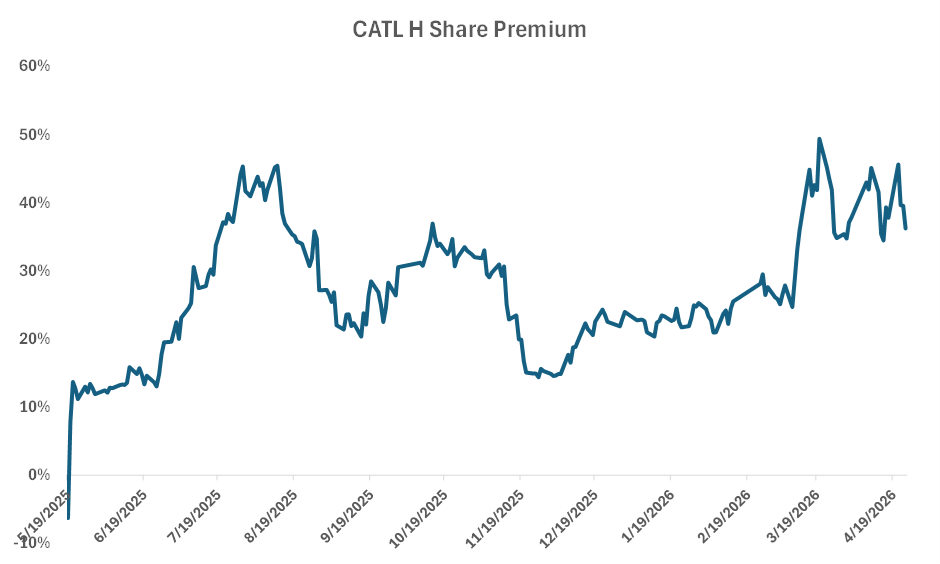
Following the strong H-share outperformance, CATL’s H share now trades at a 45% premium to its A share. This is an extraordinary level, given that the A-share is far more liquid, and that the vast majority of A-shares trade at a premium to their H-share counterparts - often an extreme one.
To put this in perspective, investors can currently choose to buy CATL’s H share at HKD 670.00, or the more liquid A-share at the equivalent of HKD 408.40.
Sinopec Oilfield Services
I’ve selected Sinopec Oilfield Services as an example of a company at the other end of the A/H pricing spectrum as we have a position in both the A-share and H-share, the H-share is currently very liquid, and the company is a beneficiary of higher oil prices in that it will likely lead to higher capital expenditure and drilling activity levels.
The A-share premium has been rising, and the A-share can currently be purchased for the equivalent of HKD 3.35. Alternatively, the H share currently trades at HKD 1.09 - less than one‑third the price of the A share.
Just think about this for a moment: you can buy a share in the company - with voting and dividend rights - for either HKD 3.35 or HKD 1.09. It defies logic that an investor would choose to pay the higher price.
Understanding the Mispricings
I’ve been analysing the relative pricing of A shares and H shares for over two decades, and I’ve become accustomed to seeing many A shares trade at a significant premium to their H‑share counterparts. Many expected these mispricings to fade after the introduction of Stock Connect, but that hasn’t happened - and in many cases, they have become even more pronounced.
What has really surprised me this time is the situation with CATL. The idea of a H share trading at such a large premium is perplexing, to say the least.
A/H spreads have historically tended to mean‑revert, and we maintain an aggressive position in CATL and several other A/H pairs in anticipation of that outcome.
In the short term, however, stock prices are driven by liquidity flows, and we may be seeing some short covering in CATL’s H share, which, along with its inclusion in the FTSE index, is contributing to the strong outperformance. Should this continue, our fund will sustain further losses.
That said, we believe the downside is manageable, given our position sizing and the fact that it is difficult to see the spread widening much beyond its current extreme level. And if the relative pricing of CATL’s A share and H share normalises, it would provide a significant performance tailwind.


Comments