
CATL A-H Mispricing
There have been numerous news stories about CATL recently. Most have focussed on how CATL is a technology leader which is pushing battery performance to a new level. Very few have mentioned the extreme pricing discrepancy between the A- and H-shares.
The worst article was (surprisingly) published by Bloomberg on April 10. Titled “CATL Short Sellers at Risk of Squeeze on Earnings Surprise”, it highlighted the large number of CATL H-shares sold short. However, it made no mention of the extreme H-share premium, which, to me, is a major oversight. Most short sellers of CATL would be targeting the A-H spread.
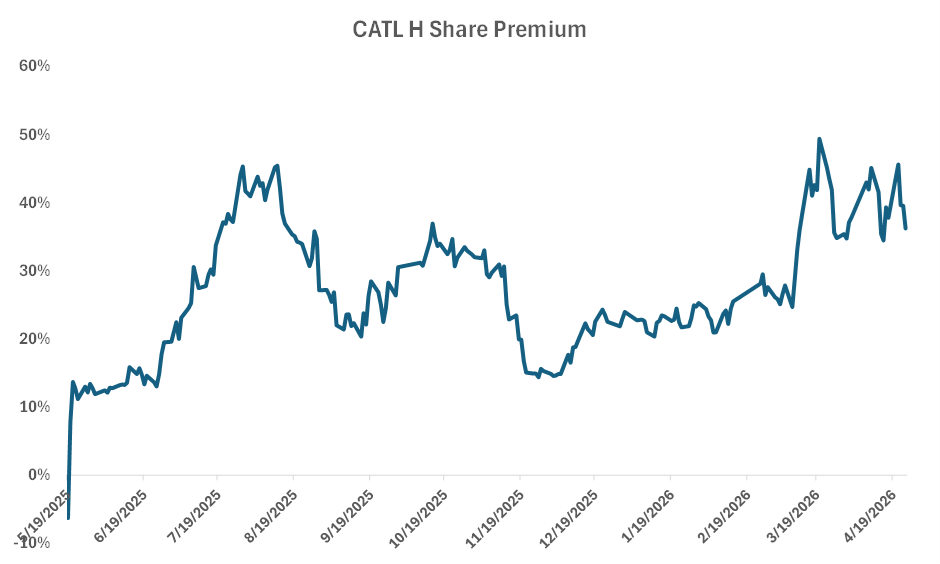
What we’re witnessing is unprecedented. At the close of trading on Friday, April 24, CATL’s H-shares were trading at a premium of more than 36% to its A-shares. CATL’s H-share premium over the last couple of months has reached levels never seen before. I’m accustomed to seeing large A-share premiums, but substantial H-share premiums are unheard of.
Given CATL’s H-shares are less liquid than its A-shares and H-shares typically trade at a significant discount to their A-share listing, I think this mispricing will be transitory.
Other market analysts see things differently. After CATL released its results in April, a J.P. Morgan analyst commented:
“We believe CATL-H warrants a 15–25% premium over CATL-A, referencing TSMC ADR vs TW shares, which have averaged a 16% premium year-to-date and peaked at 34% in Oct-2025. We believe this valuation differential reflects CATL’s global investor appeal, liquidity advantages, and sector leadership.”
None of this makes sense to me. I can see why TSMC’s U.S. listing has traded at a premium given many U.S. investors can only purchase U.S. shares, the bid-ask spread is much tighter on the U.S. exchange and there’s no stamp duty payable. CATL’s H-share has none of these advantages. Investors can access the A-share listing via stock connect, the A-share is less liquid, and stamp duty is less for A-shares than H-shares. As a side issue, it’s also interesting to note that TSMC’s ADR premium has declined significantly this year and has recently been less than 10%.
The key point is that almost anything can be justified given how dysfunctional markets have become. At least we can take some solace in the fact that the 15–25% premium suggested by the J.P. Morgan analyst is significantly lower than the current level.
Managing our CATL position has been extremely challenging. The A-H spread started blowing out in early March, as shown below.
The increase in the A-H spread hasn’t been driven by the A-share declining. In fact, the A-share has risen significantly since the start of March.
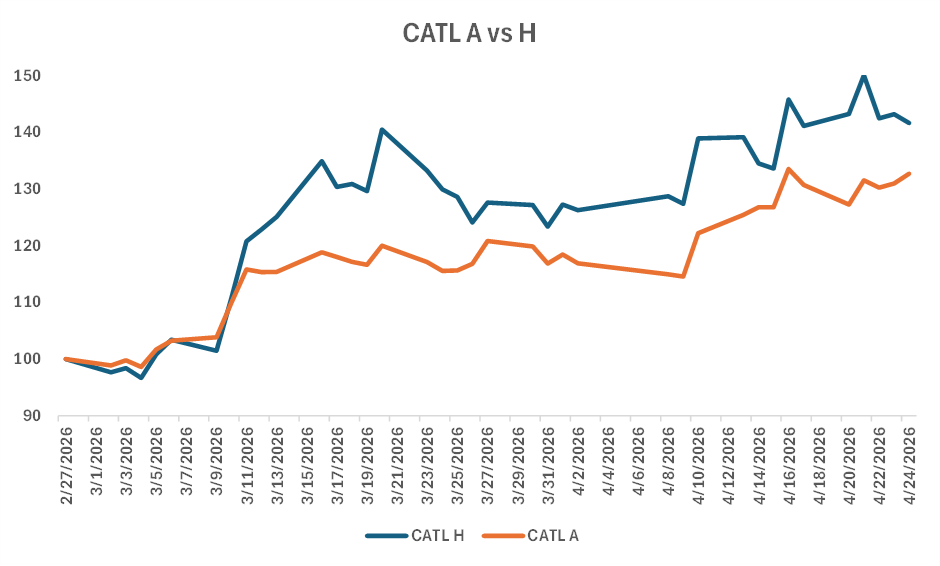
When you have an A–H share pair and both the A- and H-shares rise - but the short position appreciates faster than the long position - two things occur unless corrective action is taken. First, the gross exposure to the pair increases. Second, the net short exposure also increases.
We cannot allow this to continue unchecked. To correct for the net short exposure, I purchased additional A-shares in the second half of March, thereby increasing the fund’s overall gross exposure to CATL. I was loath to do so, given that our position was already substantial, but I viewed it as the lesser of two evils. The idea of buying the H-shares while they were trading at an absurdly high premium to their A-share counterparts was, in my opinion, more difficult to justify.
Having an outsized exposure to CATL was already a significant source of stress. The situation worsened earlier in April when short inventory in the H-shares dried up and the cost of borrow rose to around 15% per annum. It’s hard to overstate the pressure of managing a long–short portfolio, particularly when investors operate with tight drawdown limits and when unusual share price movements occur that defy logical explanation.
With the increase in the H-share borrow rate and a slight decline in the spread, my bias this month has been to reduce our exposure to the company’s A- and H-shares. These adjustments were made opportunistically, with most H-share buy orders placed at the bid to capitalize on short-term intraday pullbacks in the H-share price.
To give you a sense of how active the trading has been, the following snapshot from our Conquest portfolio management system illustrates the trading history for the stock since the beginning of April.

I would be surprised if the A-H spread doesn’t decline significantly over the rest of the year. However, with the H-share borrow rate being so high and with so much market dysfunction creating considerable short-term uncertainty, I will continue to be proactive managing the risk stemming from our CATL position, with a bias towards reducing the position further.


Comments